How to Build a Town Hall
Beginning to build
Excavation and site clearance began in December 1864 and the site was levelled ready for the building work to begin.
Warburton Brothers, a building firm from Harpurhey in Manchester, were appointed as the main contractors for the building, It’s worth noting that their price was the lowest at £26,510, which was already over £6,000 more than the budget!
Specialist contractors
Following the appointment of Warburton Brothers other tenders were advertised on a regular basis from 1868 onwards.
The committee needed to hire specialists in stone and wood carving as well as in metalwork for lighting. They needed heating and ventilation engineers, clock makers and bell founders, joiners and carpenters and even cabinet makers and upholsterers.
Crossland’s handwrote a specification for the works that covered every detail – from the building stone needed to soft furnishings. He noted that exterior walls were to be faced with Todmorden sandstone, the Exchange columns were to be imported polished granite. He listed dark Welsh slates for the roof, English oak for the floors and Turkish carpets for the Mayor’s rooms.
Bright foundations
A ceremony to lay the building’s foundation stone took place in March 1866, with John Bright, MP doing the honours.
At the event a box containing newspapers, coins, documents and information about the Town Hall was buried beneath the stone, a kind of time capsule to commemorate the beginning of works.
Artists and craftsmen
Crossland recruited a team of experts to work with him. Heaton, Butler and Bayne of London designed the overall decorative scheme. Led by main designer Clement Heaton, they were high-class stained-glass makers and architectural decorators.
Their work can be seen in the decoration of the Great Hall, Borough Court, Magistrate’s Room, Mayoral Suite and Council Room as well as all the stained glass.
The construction of the building was not without incident and the clerk of works was replaced midway through.
However, by the time of the Rearing Ceremony on 10th September 1868, these problems were set aside. The event celebrated the progress made so far in raising (or rearing) the building. A dinner was supplied by Councillor Ashworth, followed by toasts, music and singing.
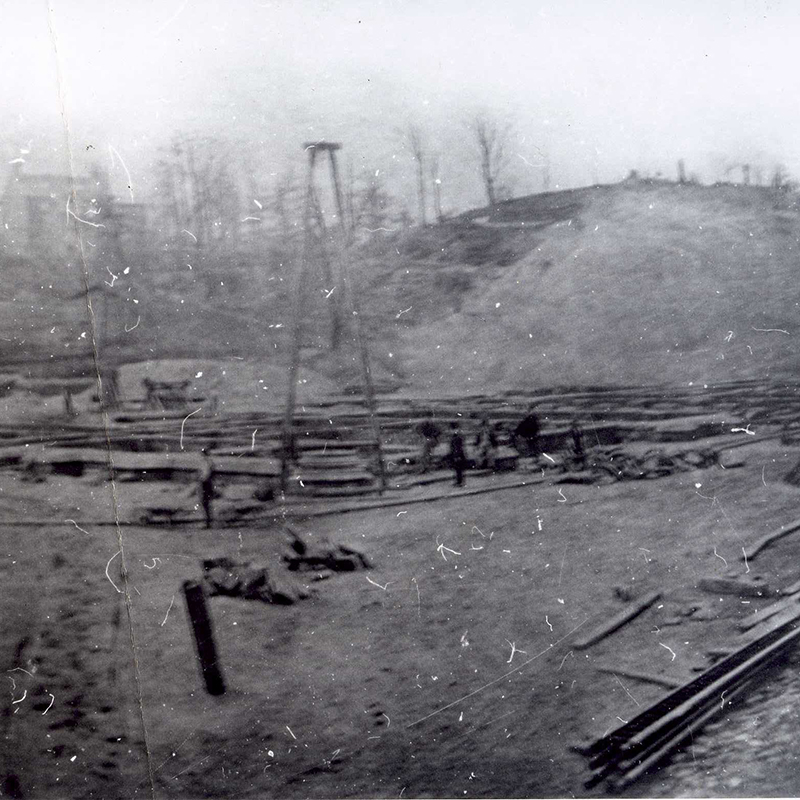
Preparing the ground for construction.