Explore the space
Old Council Chamber
When the Town Hall first opened, you weren’t allowed to look around in here, visitors were only meant to watch and listen.
This was the first purpose-built council chamber in Rochdale. Previously, the Council met in all sorts of different buildings to conduct the town’s business. The room is full of pictures which show how the council saw the town’s industrial history. Here they could discuss, debate, and often disagree in style.
You’ve probably come in through the visitors’ entrance from The Exchange. An oak screen used to keep the public separate from the meetings. Later on a glass extension was added. This kept the noise out and stopped tomatoes being thrown at councillors!
Signs and symbols
Certain symbols are found again and again in the Town Hall – sheep, cotton plants, spindles and shuttles.
Have a look around. Once you see them you’ll find them everywhere! This room is at the centre of the story that these symbols tell. Rochdale’s wealth was built on the wool industry and then on cotton.
The decorations in this room showcase this story, from ancient times and across the globe. The painted frieze along the top of the walls is a timeline of textile technology with references to Rochdale’s industry throughout.
The story continues on the stained glass, which includes the names of influential industrialists like the Duke of Bridgewater, Sir Robert Peel, Sir Titus Salt and Richard Arkwright.
King Cotton…and wool
Take a trip through time and across the world to explore how textiles were made throughout history… and in Rochdale!
The frieze is a timeline of textile industry innovation. At each end of the room, scenes show the beginning and end of the story, from the ancient world to Rochdale. In between are 22 snapshots of history showing skilled workers, inventors and scientists, new techniques and processes.
Amongst these are drawings of flowers and plants used to make and dye textiles. John Milner Allen painted the panels, whilst working for Heaton, Butler & Bayne. He researched the designs at the Patent Office in London to make sure his drawings were accurate. He added in playful hints about peoples’ lives as well.
View the slideshow to journey through the images of the frieze and discover more

The partition was removed as part of the redevelopment project
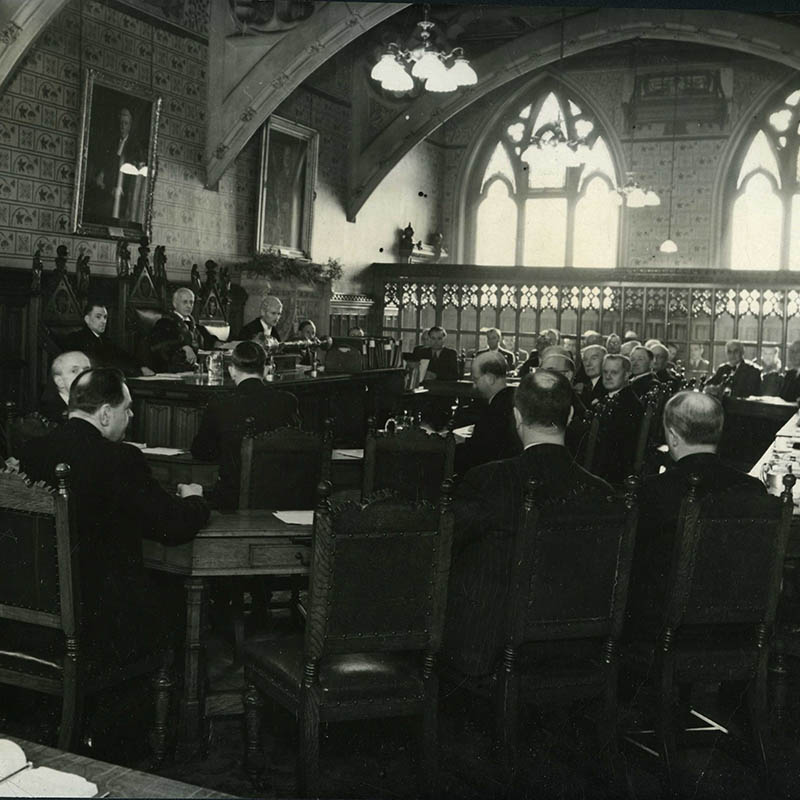
A Council meeting taking place in the Chamber in 1948