Discover more
Not ALL about cotton
Rochdale is known as a cotton town, but much of the borough’s early prosperity was built on wool and the flannel industry.
By the early 1800s, Rochdale was the national centre of production for plain-weave flannel or Rochdale flannel, as it became known. By the 1850s, it was exporting cloth to Holland, Portugal, Spain, Italy and Germany.
Cotton first made an appearance in the town in the 1780s and by 1818 over 25 cotton spinners and manufacturers were listed within the borough. As the industry grew, makers of textile machinery moved to the town and Rochdale also became home to spindle, shuttle, and bobbin makers. Not surprising then that we see them in the decorations of the Town Hall.
The other side of the story
Wool and cotton brought prosperity, but not for everyone.
The frieze doesn’t show the reality of working life for the majority of people, it’s just one side of the story.
What of ordinary Rochdale workers, rather than inventors and industrialists? Working conditions were harsh. A working week lasted from Monday to Saturday lunchtime, and a day was up to 13 hours long with a 6am start. It was no easy job. Workers faced losing fingers from unguarded machinery, breathing in cotton dust that caused lung disease, tuberculosis and cancers.
Children crawled under moving machines to pick up bits of thread and accidents were common. New laws did make work safer, but workers were not often a priority, profits were.
Rochdale, cotton and slavery
Rochdale’s cotton industry connected it directly to the slave trade, but its workers fought against it.
Cloth traders visited markets in Rochdale to purchase cotton, silk and calico. They sold their products on in other markets, some directly to manufacturers exporting to the west African coast who exchanged the finished cloths for enslaved Africans to be taken to the Americas.
Dye work was a thriving industry in Rochdale, as highlighted by the dye plants illustrated on these walls. Large quantities of dyes were sold on to cotton merchants and dye suppliers in Manchester who exported cotton, linen and silk to west Africa. Many of these suppliers were prominent investors in insurance and freight businesses for ships travelling the transatlantic slave route. Some of the direct suppliers of cloth to Liverpool slave traders also came from Rochdale.
In the liberation struggle against slavery, cotton workers in Rochdale mills refused to handle slave-grown cotton in support of the blockade of the southern US states’ cotton exports. During the cotton famine in 1862-3, the people of Lancashire received donations of food carried from America, specially donated by President Lincoln. One of these barrels (the only remaining one) is in the Touchstones collection.
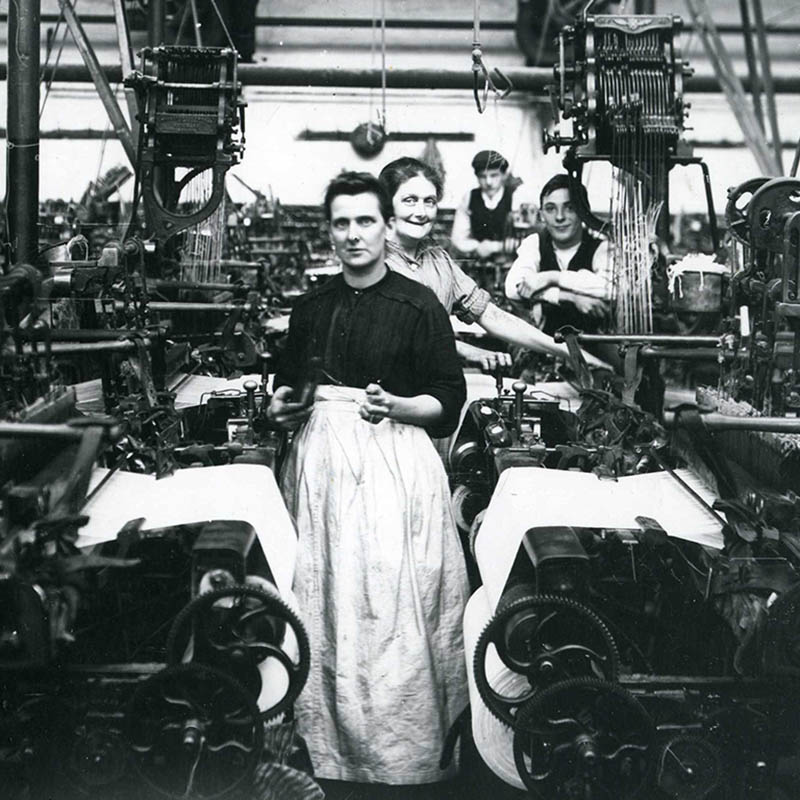
Workers in a Lancashire weaving shed in the late 1800s